Eleventh Dragoon Guards
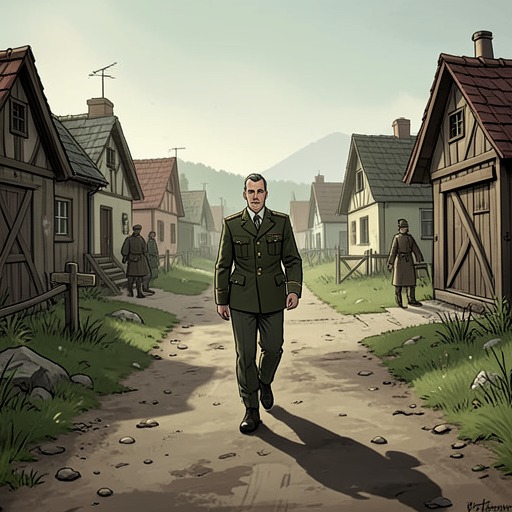
Far from the Madding CrowdThe Eleventh Dragoon Guards are the regiment whose abrupt transfer from Casterbridge sets Fanny Robin’s presumed flight in motion and whose barracks become the setting for her painful reunion with Sergeant Troy. The regiment’s departure is first reported as local news, but its military routines and restrictions soon expose the uncertainty of Fanny and Troy’s promised marriage.
Identity and Movements
The Eleventh Dragoon Guards are stationed at Casterbridge Barracks before receiving orders to leave for Melchester and continue onward. William Smallbury explains that the route came from the Government suddenly, “like a thief in the night,” so that the regiment was almost on the march before its members knew of the order. Their departure is therefore not presented as a deliberate response to local events: it is a rapid military transfer that unexpectedly changes the circumstances of people beyond the regiment.
As the soldiers pass through Casterbridge, they play “The Girl I Left Behind Me.” William recalls the music and the great drum’s force on the crowd, describing the public-house visitors and unnamed women as deeply moved. The departure is at once an ordinary movement of troops and a public spectacle, its martial display lending emotional grandeur to a journey that is not, William clarifies, directly to a war. The regiment is going to take the place of troops who may be sent to one, a distinction that does little to lessen the disruption its departure causes for Fanny.
Fanny Robin and the Rumour of Departure
When Bathsheba asks what news has come from Casterbridge, William reports that Fanny has “run away with the soldiers.” He has inferred this from the regiment’s departure and from his knowledge that Fanny’s young man belonged to it. His conclusion is plausible but unconfirmed: he does not say that he saw Fanny leave with the troops. Gabriel Oak, who saw the regiment pass, listens in doubt, while Bathsheba recognizes that no further information is likely that evening and sends word of the report to Boldwood.
The regiment’s movement thus becomes a misleading explanation for Fanny’s absence. The village has an apparent answer, but the report does not establish what happened to her or whether she has joined the soldiers. This gap matters because the military departure gives her private distress the outward shape of a simple elopement, while the fuller account shows that she is struggling to reach Troy and secure the marriage he has repeatedly promised.
The Barracks and Fanny’s Search
Fanny eventually reaches the barracks and, at night, tries to identify Troy’s window by counting the high windows in the wall. She throws snow at the fifth window until a fragment strikes it and someone opens it. The scene makes the regiment’s physical presence decisive: the barrack wall separates Fanny from Troy, and the closed gates prevent him from coming out to meet her.
When Fanny asks whether the man is Sergeant Troy, he answers suspiciously before recognizing her. She identifies herself as his wife, but their exchange reveals that this is not a settled marriage. Troy says that he had not expected her and had not thought she would come; when Fanny recalls his promise, he acts as though he does not remember it. She presses him to name when they will marry, and he says she needs proper clothes before discussing the arrangements.
Fanny raises the practical requirements herself. She asks whether they will marry by banns or licence and points out that they live in different parishes, so banns must be published in both. Troy appears unfamiliar with the implication and has not yet obtained permission from his officers. Though he agrees that they will marry, he postpones the arrangements for several days rather than fixing a date. The regiment’s rules and enclosed barracks provide the immediate obstacle to a meeting that night; more consequentially, Troy’s position within military life becomes part of a sequence of delays that leaves Fanny’s promised marriage unresolved.
Narrative Significance
The Eleventh Dragoon Guards are not developed as a collective portrait of individual soldiers. Their importance lies in how their orders reorganize the plot: a sudden transfer produces village speculation, supplies the apparent explanation for Fanny’s disappearance, and brings her search for Troy to a guarded military threshold. The regiment’s movement is impersonal, but its consequences are intimate. Against the music and spectacle of the marching troops, Fanny’s slow approach to a window turns departure into separation and makes visible the distance between a promise of marriage and the actions required to fulfill it.